What Chemicals to Add to Hot Tub the First Time
If you’re a new hot tub owner, knowing which chemicals to add during the initial setup is crucial for maintaining clean and safe water. This guide outlines the steps and considerations for balancing the water chemistry in your hot tub.
Steps to Add Chemicals to Your Hot Tub
1. Fill Your Hot Tub with Water
- Ensure the water level meets the manufacturer’s recommendations.
- Run the pump for at least an hour to circulate the water.
2. Test the Water Chemistry
Use chemical testing strips or kits to measure the pH, alkalinity, and chlorine/bromine levels. These readings will help determine which chemicals to add.
3. Balance the Alkalinity
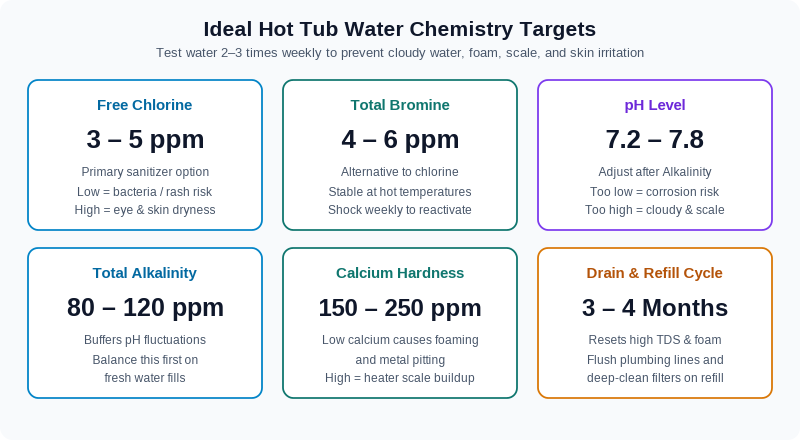
- Ideal Range: 80–120 ppm.
- Low Alkalinity: Add an alkalinity increaser.
- High Alkalinity: Use a pH decreaser, which lowers both pH and alkalinity.
Note: Always balance alkalinity before adjusting the pH.
4. Balance the pH Levels
- Ideal Range: 7.2–7.6.
- Low pH: Add a pH increaser.
- High pH: Use a pH decreaser.
Proper pH balance ensures sanitizers work effectively and prevents scaling or corrosion in the hot tub.
5. Add a Sanitizer
Sanitizers kill bacteria and germs in the water. Choose between:
- Chlorine: Maintain levels of 3–5 ppm. Chlorine provides effective sanitization but may have a noticeable chemical smell.
- Bromine: Maintain levels of 3–5 ppm. Bromine is gentler on the skin and doesn’t emit a strong odor. Available as tablets or liquid.
Tip: After adding sanitizer, let the water circulate for 15 minutes before retesting the levels.
Ongoing Maintenance
- Regularly test and adjust chemical levels to ensure water remains clean and safe.
- Follow the dosage instructions on chemical containers based on your hot tub’s water capacity.
- Replace the water if it becomes cloudy or difficult to balance.
First-Fill Target Chemistry & Dosage Reference
Before bathing for the first time, test fill water and balance parameters in order—Total Alkalinity first, then pH, Calcium Hardness, and finally Sanitizer. Always follow exact scoop or capful measurements printed on your specific chemical bottle.
| Parameter | Target Range | Adjustment Chemical | Typical Role |
|---|---|---|---|
| Total Alkalinity (TA) | 80 – 120 ppm | Sodium bicarbonate (Alkalinity Increaser) | Buffers pH so acidity doesn’t swing wildly |
| pH Level | 7.2 – 7.6 | Sodium bisulfate (Down) / Sodium carbonate (Up) | Prevents eye sting, scale, and pump corrosion |
| Calcium Hardness (CH) | 150 – 250 ppm | Calcium chloride (Hardness Increaser) | Prevents foamy soft water and metal heater pitting |
| Free Chlorine | 1 – 3 ppm (up to 5 ppm startup) | Dichlor spa granules | Destroys bacteria and organic contaminants |
| Total Bromine | 3 – 5 ppm | Bromine granules / tablets + booster | Low-odor sanitizer stable in warm water |
Startup Preparation Checks by Gallon Capacity
- Pre-Treat Well or Hard Water: If filling from a well or municipal source high in iron, copper, or calcium, add a metal/stain sequestrant right as water covers the footwell and attach a hose pre-filter before filling.
- Use the Circulate-and-Wait Rule: Never dump alkalinity, pH, and sanitizer chemicals simultaneously. Run jets with air valves closed for 15–20 minutes between each adjustment, retesting with accurate spa test strips before adding the next product.
- Keep Cover Open 20–30 Minutes After Shocking: Leaving the thermal cover open briefly after startup shock allows off-gassing so fumes don’t bleach pillows or degrade the underside vinyl vapor barrier.
- Check Approximate Dosage Scale: A 400-gallon spa requires roughly double the chemical volume of a compact 200-gallon 2-person spa—double-check label charts before measuring.
3 Common First-Time Startup Mistakes
- Using Pool Trichlor Tablets in Spas: High-acid pool chlorine tabs dissolve too fast in 104°F water, plummeting pH and corroding stainless heater elements and pump seals. Only use spa-formulated dichlor granules or bromine tablets.
- Skipping Calcium Hardness: Ultra-soft water aggressively foams when jets run and can slowly etch metal components; aim for 150–250 ppm.
- Adjusting pH Before Alkalinity: Raising or lowering pH first often bounces back within hours if Total Alkalinity isn’t already locked into 80–120 ppm.
Conclusion
Adding the correct chemicals in the proper order is key to maintaining a sanitized hot tub. Balancing alkalinity, pH, and sanitizer levels ensures a safe and enjoyable soaking experience. Remember, hot tub water requires ongoing monitoring and maintenance to remain in top condition.
If you have questions about first-time hot tub startup chemistry or balancing sequence, feel free to contact our team.
References: