Hot Tub vs. Jacuzzi vs. Spa – What’s the Difference?

Hot Water Treatment and Its Benefits
Hot water treatment has a range of benefits covering all kinds of health issues that people often face when dealing with the stress of daily life. Spending some time in a hot tub is a great way to unwind, relax, and feel rejuvenated after a long day at work or a busy day spent outdoors.
Hot tubs also have a range of benefits for senior citizens. Soaking in a hot tub can help in relieving pain in joints, increasing blood circulation, and promoting better sleep. Above all, it provides the relaxing and soothing experience of soaking in a hot tub. Soaking in a hot tub for as little as 20-30 minutes can have far-reaching benefits.
Hot water therapy has shown to have a positive impact on reducing instances of headaches and migraines. Spending some time relaxing in hot water can also help to make your skin look better as hot water improves blood circulation and flushes out toxins from your body.
When it comes to hot water treatment, people often choose hot tubs, spas, or jacuzzis. While these terms are used interchangeably, there are several differences between the three. If you’re in the market for buying any of these, it helps to know what each term actually stands for and what kind of features you can expect in each. In this article, we take a look at the differences, features, pros, and cons of buying hot tubs, spas, and jacuzzis.
Differences Between Hot Tubs, Spas, and Jacuzzis
Although buyers and retailers often use all three words interchangeably, each term points to a distinct combination of brand trademark, construction style, and installation method. Here is how they compare side by side:
| Attribute | Hot Tub (Generic) | Jacuzzi® (Brand Name) | Spa (Broad / Custom Category) |
|---|---|---|---|
| Term Meaning | Generic category for freestanding heated tubs | Registered trademark of Jacuzzi Brands Corp. | Umbrella term spanning in-ground pool spas & standalone hydrotherapy units |
| Typical Installation | Above-ground on concrete pad, patio, or reinforced deck | Above-ground acrylic cabinet or built-in indoor/outdoor jetted tub | In-ground custom gunite/tile beside a pool, or commercial/portable spa |
| Portability | High to moderate (inflatable & portable acrylic can move) | Moderate on freestanding cabinets; none on built-in jetted tubs | None for custom in-ground builds; moderate on above-ground spa shells |
| Typical Cost Range | $400 – $8,000 (inflatable to mid-range acrylic) | $7,000 – $20,000+ (premium brand pricing) | $4,000 portable to $25,000+ for custom excavated in-ground |
| Best For | Value buyers, renters, plug-and-play or flexible backyard setups | Proprietary hydromassage jets, luxury aesthetics, dealer service | Seamless pool integration, permanent architectural landscaping |
1. What Is a Hot Tub? (Above-Ground & Portable Units)
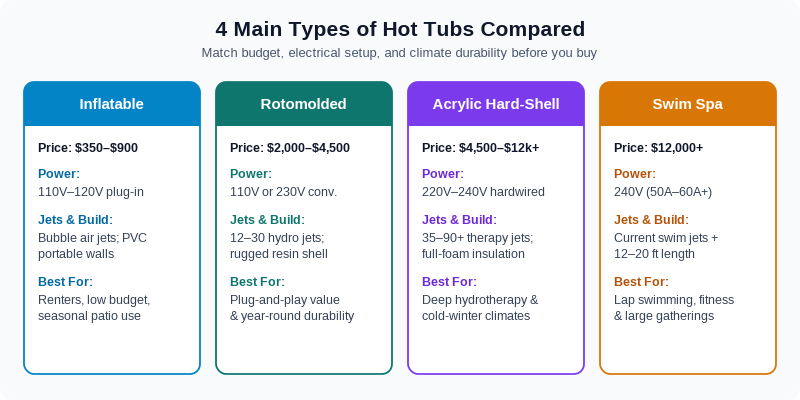
Historically, hot tubs were barrel-stave wooden tubs banded with steel hoops. Today, the term refers broadly to self-contained above-ground vessels built from vinyl (inflatables), rotomolded polyethylene, layered acrylic, or cedar—housing pumps, heater, filtration, and controls neatly inside the cabinet.
Entry-level portable hot tubs can be plugged straight into a standard 120V GFCI outlet with zero excavation, while larger multi-pump acrylic hot tubs connect to hardwired 240V circuits for year-round hydrotherapy.
View Portable 120V Hot Tub on Amazon
Check Top-Rated Portable Spa on Amazon
Pros & Cons of Above-Ground Hot Tubs
- Pros: Lower purchase and installation cost; portable enough to relocate with movers; insulated locking covers retain heat efficiently; simple water care with replaceable filters.
- Cons: Inflatable vinyl models carry shorter lifespans and softer seating; 120V models warm slower (~1–2°F/hr) in freezing air; cabinet occupies patio footprint above deck height.
2. What Is a Jacuzzi? (Brand Trademark vs. Generic Usage)
Jacuzzi is not a generic product design—it is a registered trademark owned by Jacuzzi Brands Corp. Founded by Italian immigrant brothers who began in aviation hydraulics before inventing the submerged hydrotherapy pump in the 1950s, Jacuzzi became synonymous with jetted whirlpool baths and outdoor hot tubs.
Features, Advantages & Trade-Offs of Jacuzzi-Brand Units
- Key Strengths: Proprietary targeted PowerPro hydromassage jets, sleek molded ergonomics for 4–7 adults, rapid 240V heating recovery, strong dealer warranty support, and strong resale perception.
- Trade-Offs: Premium upfront cost compared with factory-direct brands; mandatory licensed 240V electrical installation on flagship models; indoor whirlpool setups require dedicated ventilation to prevent humidity buildup.
3. What Is a Spa? (In-Ground Pool Spas vs. Standalone Spas)
Within the pool and patio industry, "spa" refers either to modern molded acrylic hydrotherapy tubs equipped with targeted jet therapy OR to permanent in-ground gunite/fiberglass vessels plumbed alongside an inground swimming pool.
Pros & Cons of In-Ground & Custom Spas
- Pros: Custom spillover walls and stonework elevate backyard architecture; generous seating legroom for entertaining groups; seamless hot-cold transition beside a swimming pool.
- Cons: Highest installation cost (excavation, trenching, custom plumbing); slower heating when sharing pool equipment; repairs to underground lines can require concrete cutting.
Frequently Asked Questions
Q1) Are a Jacuzzi and a hot tub the same thing?
Ans. Not strictly. “Hot tub” is the generic product category for freestanding heated hydrotherapy tubs, while “Jacuzzi” is a registered brand trademark owned by Jacuzzi Brands Corp., which sells both portable and in-ground spas.
Q2) What is the main difference between an in-ground spa and a portable hot tub?
Ans. An in-ground spa is custom-built into your patio or swimming pool plumbing with permanent excavation, whereas a portable hot tub arrives as a self-contained inflatable, rotomolded, or acrylic cabinet that can be moved if you relocate.
Q3) Does running a Jacuzzi or backyard hot tub significantly increase electricity bills?
Ans. Modern well-insulated acrylic tubs and 240V Jacuzzis typically add $30–$65 per month in electricity when fitted with an intact ASTM thermal cover, depending on local utility rates and winter air temperatures.
Q4) Can I install a hot tub or spa myself without an electrician?
Ans. Yes for 110V/120V plug-and-play inflatables and compact rotomolded tubs using an existing GFCI outlet; however, 220V/240V acrylic spas and Jacuzzis require a licensed electrician for GFCI subpanel wiring and permits.
Q5) Can I take a hot tub or spa with me when I move homes?
Ans. Portable above-ground acrylic, rotomolded, and inflatable hot tubs can be drained and relocated with movers, while custom in-ground masonry spas remain permanently fixed to the property.
Conclusion
Choosing between a hot tub, spa, or jacuzzi depends on your personal preference, requirements, and budget. Each has unique features and benefits suited for different uses. Whether you aim for therapeutic massages, a relaxing soak, or a luxurious experience, understanding the differences can help you make an informed decision.